Coding agents can turn a work item into a pull request. That changes the questions engineering leaders need to ask. Was the agent given the right context? Was its output checked? Can the team show who authorized the work, which controls applied, and why the resulting change was accepted?
Recent announcements from Atlassian and Qodo show how quickly these questions are moving into everyday development workflows. They also give us a useful way to think about three complementary roles: work and context, code quality and review, and authority and evidence.
1. Work and context: Atlassian and Jira
An agent needs to understand the work it has been asked to do. The Jira issue, related decisions, team knowledge, and review checkpoints all help turn a prompt into an accountable unit of work.
Atlassian describes Jira and Teamwork Graph as connecting requirements, organizational knowledge, code context, agent assignments, session visibility, and human review. Its newer governed agent loops announcement adds plans for continuous backlog-to-pull-request workflows, agent context controls, standards, AI review, and usage measurement. Atlassian explicitly calls this governance; it would be inaccurate to suggest otherwise.
Availability matters here. In that September announcement, Atlassian says Code Context is rolling out through open beta; Agent loops, Standards, and AI Review are in private early access; and Agent Context Controls and the Agent Usage Dashboard are planned for general availability in the coming months. Teams should confirm the status of each capability in their own Atlassian plan before relying on it.
2. Code quality and review: Qodo
The second question is whether the proposed change fits the system it will affect. That takes more than a diff: it can require repository history, dependencies, organizational standards, and a way to resolve findings before and after a pull request.
Qodo's Agentic Toolbox brings codebase context and rules into coding-agent sessions. Qodo says its tools can review committed and uncommitted local changes before a pull request, return structured findings, and bring pull-request review issues back into the session for resolution. Qodo also describes rule management, permissions, and auditability as part of its own governance approach. Human judgment remains part of the workflow for consequential decisions.
This is a strong answer to a code-quality question: Does the change make sense in this codebase, against this team's standards?
3. Authority, provenance, and policy evidence: the Secuarden lens
There is a related question that spans the work item, the coding session, the review, and the eventual merge: Can we reconstruct the chain of authority behind this change?
For an AI-assisted change, that chain may need to show the human who initiated the work, the agent and session involved, the instructions and permissions in force, the tools used, the code affected, the policy decisions made, the checks performed, and the approvals or exceptions recorded. An independent evidence boundary means that those records can be inspected outside the agent's own account of its actions. Atlassian and Qodo also provide governance controls; independence here describes the trust boundary around the evidence.
We built Secuarden to preserve the evidence behind AI-assisted code changes. In supported workflows, we capture agent and tool activity, connect it to the developer, repository, and resulting code change, and preserve a verifiable session record. Our policy gates link control decisions to that record so teams can inspect how a change moved from human intent to accepted code. The exact evidence available depends on the agents and controls a team has deployed.
One change, three questions
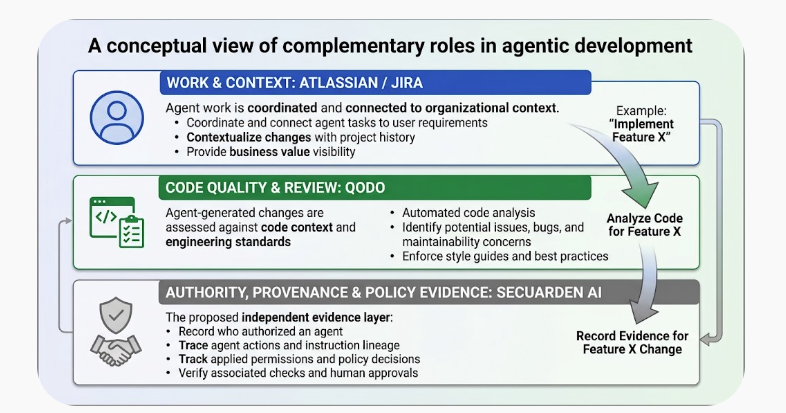
Imagine an agent is asked to implement a feature. Jira can hold the intent and coordinate the work. Qodo can bring relevant code context and standards into the session and review the proposed change. A separate provenance and policy-evidence layer can help the organization inspect the authority and control record attached to that change.
These roles overlap. Atlassian has review and governance features; Qodo has rules and governance features; Secuarden's focus is on evidence and control across the path from instruction to code. The diagram is a way to ask whether the full path is covered, including the boundaries between tools. Each product can also be useful on its own.
If your team is adopting coding agents, which part of that path is hardest for you to verify today: the original intent, the quality of the change, or the authority and evidence behind it?